Blogs, news & views
Stay informed, stay compliant, stay ahead. Explore blogs, articles, news stories, and webinars from industry thought leaders, change-makers, and the Culture Shift team.

Third Party Harassment: The Blind Spot in Most Workplace Harassment Policies
Most harassment policies are built around one scenario: two colleagues, one incident. But a lot of harassment comes from outside the organisation - customers, clients, patients, delegates - and the law is catching up. Learn what third party harassment looks like in practice, where employer liability stands under the Worker Protection Act, and what changes from October 2026 under the Employment Rights Act, including a higher bar for "reasonable steps" and liability from the first incident.
.png)
Protected Beliefs in the Workplace: What Employers Need to Know
Protected beliefs have become one of the most challenging areas of employment law and workplace culture. At Culture Shift's Annual Conference, employment law experts and workplace culture specialists discussed the growing complexity of protected beliefs, conflicting rights and how organisations can respond fairly and legally.
How to Build Trust in Workplace Misconduct Reporting
In a recent article for HRZone, Gemma McCall explores why organisations need to stop viewing workplace misconduct as a reporting problem and start addressing the trust issues that prevent people from speaking up in the first place.
Why Whistleblowing Protections Are Not Enough
The launch of the CIISA standards marked a significant moment for the creative industries, signalling growing recognition of the need for stronger protections around bullying, harassment and misconduct across film, television and wider media environments. But in a recent article for Broadcast Now, we highlight that whistleblowing protections alone will not solve the deeper cultural issues that have allowed harmful behaviour to persist for years.
.png)
Speaking Up in the Creative Industries – Embedding Standards in Practice
With the CIISA Standards having been in place for a year and with the introduction of the Employment Rights Act, expectations around creating a healthy and effective speak up culture are shifting. Organisations being asked to move beyond policy and demonstrate how they are creating real, effective speak-up cultures.

The Pitfalls of Microsoft Forms for Misconduct Reporting
Discover why Microsoft Forms falls short for misconduct and harassment reporting, and find out what HR teams need instead to meet the Employment Rights Act's “all reasonable steps” requirement.
.png)
From the Conference Floor: Real-World Lessons for HR Leaders
Workplace misconduct is evolving, and many HR processes are struggling to keep up. At this year’s Culture Shift Annual Conference, one thing was clear: what worked even a year ago isn’t enough anymore. In this webinar join Gemma McCall (CEO) and Charlotte Taylor (Training Manager and ED&I Specialist) as they bring the most important conversations from the conference floor into a practical session for HR, People and Compliance leaders. You’ll hear what industry experts and legal professionals are seeing right now, and what it means for how you design, communicate and manage your approach to misconduct.
%20(1).png)
Why the CIISA Standards Demand a New Approach to Reporting
For decades, the creative industries have operated under a silent contract. In exchange for the opportunity to work in world-class institutions, staff and freelancers were often expected to tolerate “difficult” environments. Harmful behaviour was frequently excused as a byproduct of creative brilliance or simply accepted as part of the job.
Why Insurers Need to Treat Reporting Data as Cultural Intelligence
In our recent article for Insurance Post, we explore how insurers can use anonymous reporting data not simply as a record of incidents, but as a valuable source of organisational insight.
.png)
Common Challenges: Employee Safety & Wellbeing
Employee safety and wellbeing is still, in many organisations, framed as something separate from “core business”. It sits in wellbeing programmes. It sits in policies, resources, and initiatives that are often well-intentioned but structurally peripheral to how work is actually designed, experienced, and managed.
UK Workplace Harassment Statistics Reveal a Culture of Silence
Bullying, harassment and workplace misconduct remain far more common than many organisations are willing to admit. While businesses continue to invest in wellbeing initiatives and employee engagement, new research into UK workplaces suggests there is still a significant gap between policy and reality.
Law Firms Are Still Treating Workplace Misconduct as Isolated Incidents
The legal profession is well positioned to advise organisations on workplace culture, reporting systems and harassment prevention. But new commentary for Practical Law from our CEO and Co-founder, Gemma McCall, questions whether many firms are applying the same standards internally.
Seniority Confidence Gap When It Comes To Speaking Up
New research into workplace bullying and harassment has uncovered a widening confidence gap between junior employees and senior leaders when it comes to speaking up at work.
Deepfakes Are Creating a New Workplace Harassment Risk
Bullying, harassment and workplace misconduct remain far more common than many organisations are willing to admit. While businesses continue to invest in wellbeing initiatives and employee engagement, new research into UK workplaces suggests there is still a significant gap between policy and reality.
%20(1).png)
UK Employees Are Scared to Speak Up About Bad Behaviour in the Workplace
Bullying and harassment are rife in UK workplaces, but many employees aren’t speaking up about their experiences. We surveyed over 1,000 UK employees – across all levels and business sizes – at the beginning of 2026 about their experiences of workplace bullying and harassment and found a pervasive fear of speaking up.
From Silence to Safety: Strengthening Speak Up Pathways in NHS Trusts
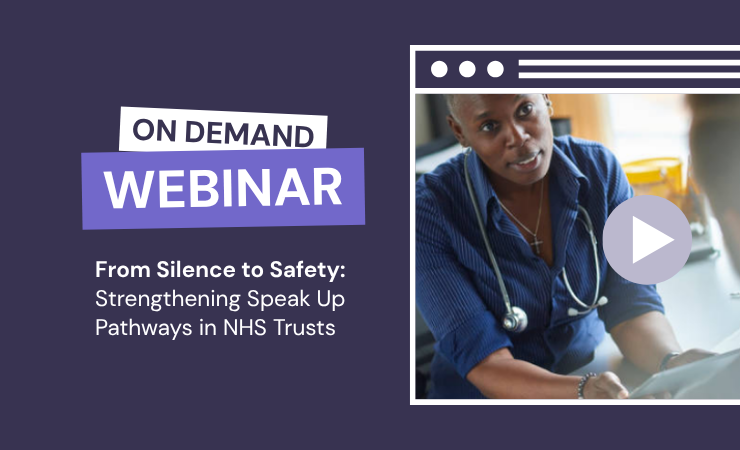
In this session, Gemma McCall and Charlotte Taylor explored the real barriers to speaking up within NHS Trusts and shared the practical experiences of Gloucestershire Hospitals NHS Foundation Trust. Discover how they implemented Culture Shift’s Report + Support™ platform to build trust, support managers, and strengthen their Speak Up culture.
AI Is Changing Workplace Harm Faster Than Employers Can Respond
From manipulated images to synthetic video, deepfakes are no longer a distant or theoretical risk. They are already beginning to show up in workplace contexts, creating new forms of harassment that are harder to detect, harder to prove, and significantly more damaging for those targeted.
.png)
Common Challenges: Regulatory Compliance
Regulatory compliance in the workplace has traditionally been treated as a legal and procedural discipline. Policies are written to reflect statutory requirements, training is delivered to ensure awareness, reporting lines are established to demonstrate accountability, and evidence is collected to satisfy audits, regulators, and internal governance structures.
%20(1).png)
How One HR Team Transformed Their Casework
For a long time, the team at a busy partner organisation knew that their current way of working was no longer sustainable. Using Report + Support to receive incoming reports, they were providing a secure and accessible way for people to come forward. Yet when the actual casework began, the process moved away from the digital space and into a world of manual administration.

Changing the Script: How the National Theatre is Redefining Workplace Culture
Behind the scenes, the National Theatre has been driving meaningful cultural change – building an environment where people feel safe, respected and heard. In this recorded conversation, Gemma McCall, CEO and Co-Founder of Culture Shift, speaks with Sarah Dean, People Policy and Engagement Partner at the National Theatre, about why the organisation adopted Culture Shift’s Report + Support™ system and what they’ve learned along the way.
%20(1).png)
Sexual Harassment in the Workplace - Guidance for Employers
Sexual harassment is a problem that affects millions of workers each year in the UK. It is estimated that 40% of women and 18% of men have experienced some form of unwanted sexual behaviour in the workplace, with studies consistently revealing high prevalence levels. It impacts both people and businesses, with significant consequences for employee wellbeing, organisational culture and business performance.
.png)
Addressing the Gap Between Reporting and Prevalence of Bullying
Bullying and harassment remain significant challenges across education and workplace environments, yet reporting levels continue to fall far below actual prevalence. In many cases, people do not stay silent because reporting routes are unavailable, but because they are unsure whether they will be believed, supported, or safe after speaking up.
%20(1).png)
How Culture Shift Can Help Your Organisation Comply with the Worker Protection Act
A practical breakdown of what the Worker Protection Act asks of employers, and how Culture Shift’s platform and Community of Practice support each step.
%20(1).png)
%20(2).png)

Feeling inspired?
Take the first step toward preventative misconduct management with a demo of our Report + Support™ platform. We can show you how to breakdown reporting barriers with anonymous 2-way messaging, and how to act before things escalate with name-matching and pattern-spotting across our analytics dashboard.