

Anonymous reporting that enables safe, trusted, and early disclosure
Report + Support™ makes it easy for people to report concerns anonymously or by name, helping organisations surface issues and regulatory risk early, and evidence the reasonable steps required under the Employment Rights Act's duty to prevent harassment.
Trusted by, quite literally, millions of employees.




Half the story
57% of employees don't report bullying or harassment, yet 91% of HR professionals believe employees feel safe to speak up. When people don't feel safe to speak up, organisations lose visibility of risk and fail to act before issues escalate. (Source: Culture Shifters Annual Report)
Fear prevents disclosure
Employees often stay silent due to fear of retaliation, the risk to their career, or a lack of confidence that action will be taken.
Low reporting, high risk
A lack of reports is often misinterpreted as a lack of issues, leaving serious risks hidden and unaddressed.
.png)
Incomplete or poor-quality information
Unstructured or informal reporting leads to missing details, making it harder to assess risk and take appropriate action.


The full picture
Create a reporting experience that builds trust, removes barriers, and ensures you capture the information needed to act.
Anonymous and named reporting
Give individuals the choice to report in a way that feels safe to them, increasing reporting rates and surfacing issues earlier.
.png)
Capture clear, structured information
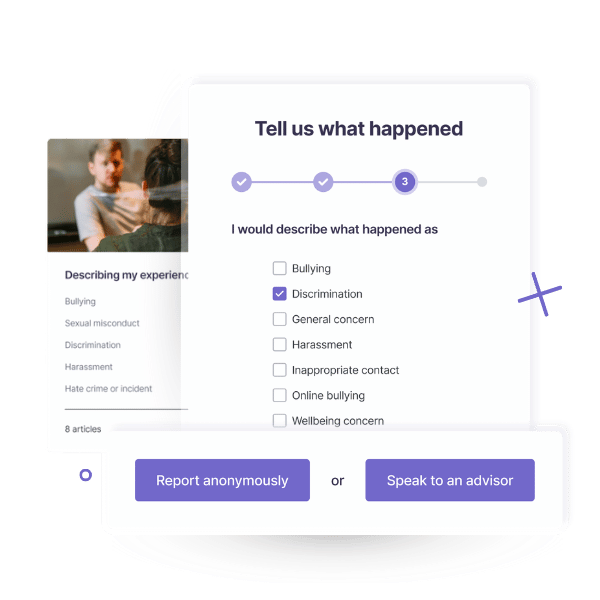
Step-by-step reporting ensures you collect consistent, relevant details that support effective triage and case management.
Build trust through transparency and control
A clear, user-friendly process reassures individuals that their report will be handled properly, increasing confidence to speak up.
What our customers say
Hear how teams are creating safer, more open workplaces by giving people the confidence to speak up - and the tools to act when it matters most.
"We were seeing trends that we were able to push up into committee structures and say - 'We know where our problems are. We know what our resourcing needs to look like.'"


"Report + Support™ has been an instrumental tool for us in terms of addressing barriers to reporting unwanted behaviours, as well as monitoring trends and collecting data insights to inform our preventative and response strategies."
"It is highly user‑friendly, intuitive to navigate, and continually evolving - actively streamlining and improving processes in response to community‑driven feedback."

"The thing I value most about the Report + Support system is that it's safe, it's secure, but also provides an avenue for you to seek support. Not only to report, but you can also ask for support through the system."

"It's enabled us to be really data driven. We know that the issues are there, but having that reporting tool where we can actually capture how many reports are coming in, the data on the different types of issues that are being experienced, we can obviously then amend and create our services with that in mind."



Encourage reporting without compromising control
Report + Support™ is designed to remove barriers to speaking up while ensuring your organisation receives high-quality, actionable information from every report.
.png)
Anonymous reporting
Allow individuals to report concerns without revealing their identity, reducing fear of retaliation and increasing the likelihood that issues are reported early. Optional two-way messaging ensures you can still request further information where needed.
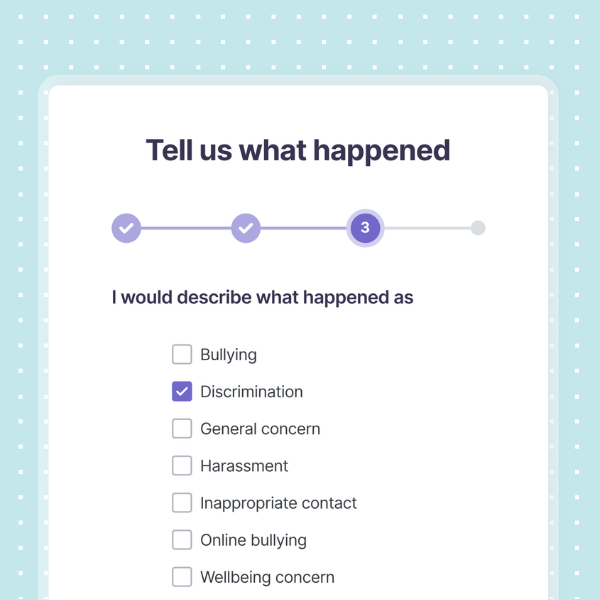
Guided reporting journey
A structured, step-by-step process helps users share relevant details clearly and confidently. This improves the quality and consistency of reports, enabling faster, more informed decision-making.
.png)
Branded reporting experience
Align the reporting platform to your organisation’s identity to reinforce trust and ownership. Show your people that reporting is taken seriously and managed internally, not outsourced or ignored.
The misconduct you don’t know about is the risk you can’t manage
Find out how Report + Support™ turns silence into actionable insight. We’ll show you how to remove reporting barriers, enable anonymous two-way communication, and capture the information you need to act early and effectively.


FAQs
Questions about Report + Support™ or misconduct reporting? We've got answers.
Anonymous reporting allows employees to raise concerns without revealing their identity. This helps reduce fear of retaliation and increases the likelihood that sensitive issues, such as bullying, harassment, or misconduct, are reported.
Anonymous reporting is important because it removes one of the biggest barriers to speaking up: fear. By giving people a safe way to report concerns, organisations gain greater visibility of risks and can act earlier to prevent issues escalating.
It's increasingly difficult to demonstrate compliance to regulators or tribunals without it. The EHRC guidance that tribunals rely on explicitly recommends anonymous reporting, and the Employment Rights Act 2025 will require employers to take "all reasonable steps" to prevent harassment. Without it, proving compliance becomes significantly harder.
Named reporting includes the individual's identity, enabling direct follow-up and formal investigation. Anonymous reporting removes that barrier, capturing concerns that would otherwise go unreported. With two-way communication, organisations can still gather detail whilst removing the perceived risks for the reporter. Offering both increases reporting rates and gives a fuller picture of what's really happening.
Structured reporting ensures that key information is captured consistently across all reports. This improves the quality of data, supports faster triage, and enables more effective case management and decision-making.
Without a proper reporting system, organisations risk underreporting, delayed identification of issues, poor-quality information, and an inability to evidence that concerns were handled appropriately. This increases legal, cultural, and reputational risk.
Yes. Anonymous reports can still provide valuable information about patterns, behaviours, and risks. With structured reporting and optional anonymous follow-up communication, organisations can gather enough detail to assess and act on concerns.
Reporting is the first step in the process. It captures concerns, which then move into case management for investigation and resolution, and analytics to identify patterns, trends, and organisational risks.
Still have questions?
Get clarity on what will actually work for your people and your compliance needs. We're here to help.