UK Employees Are Scared to Speak Up About Bad Behaviour in the Workplace
%20(1).png)
Bullying and harassment are rife in UK workplaces, but many employees aren’t speaking up about their experiences. We surveyed over 1,000 UK employees – across all levels and business sizes – at the beginning of 2026 about their experiences of workplace bullying and harassment and found a pervasive fear of speaking up.
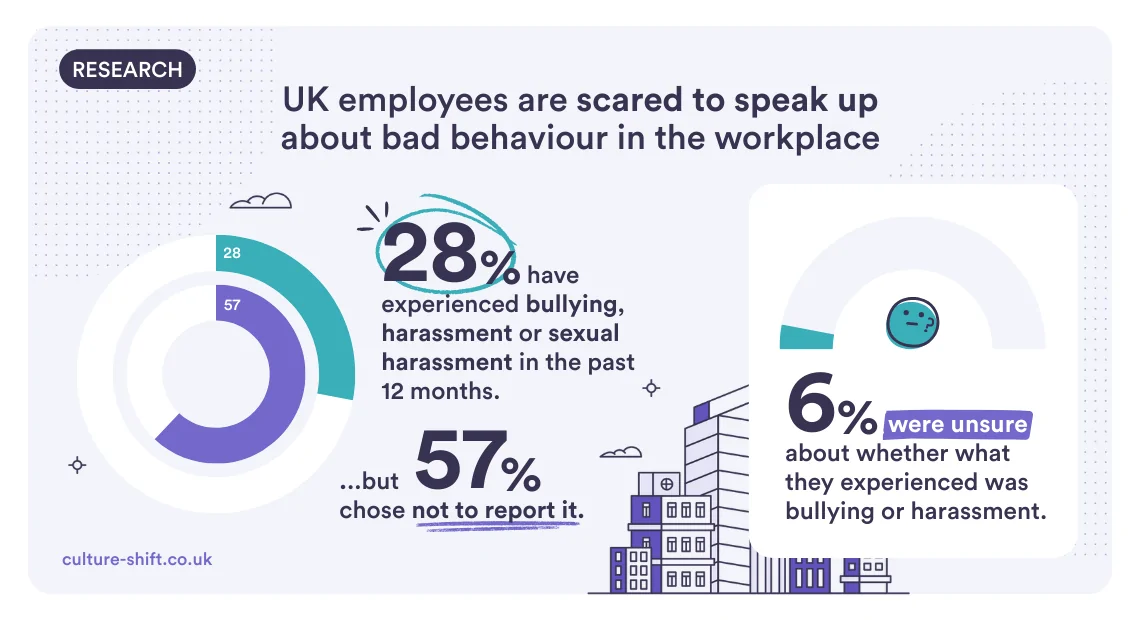
While over a quarter (28%) of people have experienced bullying or harassment at work over the past 12 months, almost 60% of those chose not to report it. For many, this was due to fear, not feeling psychologically safe enough, or the feeling that nothing would be done about it if they did report an issue. 37% of respondents said speaking up ‘isn’t worth the personal risk’. These findings are unsettling but not surprising, particularly considering today’s job market where employees are increasingly worried about job security and therefore often sticking in organisations where they don’t feel psychologically safe, or that don’t align with their core values.
Despite increasing efforts from many businesses in the area of workplace misconduct over the past few years, including the introduction of stricter policies, reporting pathways, and training around workplace misconduct, many still aren’t getting it right. Getting this right will become even more crucial from October this year, when business will be required to prove they have taken all reasonable steps to prevent (sexual) harassment in line with the Employment Rights Act.
Our research also found a significant confidence gap between senior and junior employees, with junior colleagues twice as likely (54%) as senior leaders (27%) to say that speaking up about workplace issues is ‘pointless’ because ‘nothing meaningful will be done about it’. While these numbers are relatively high across the board, this is clearly a bigger issue for junior employees.
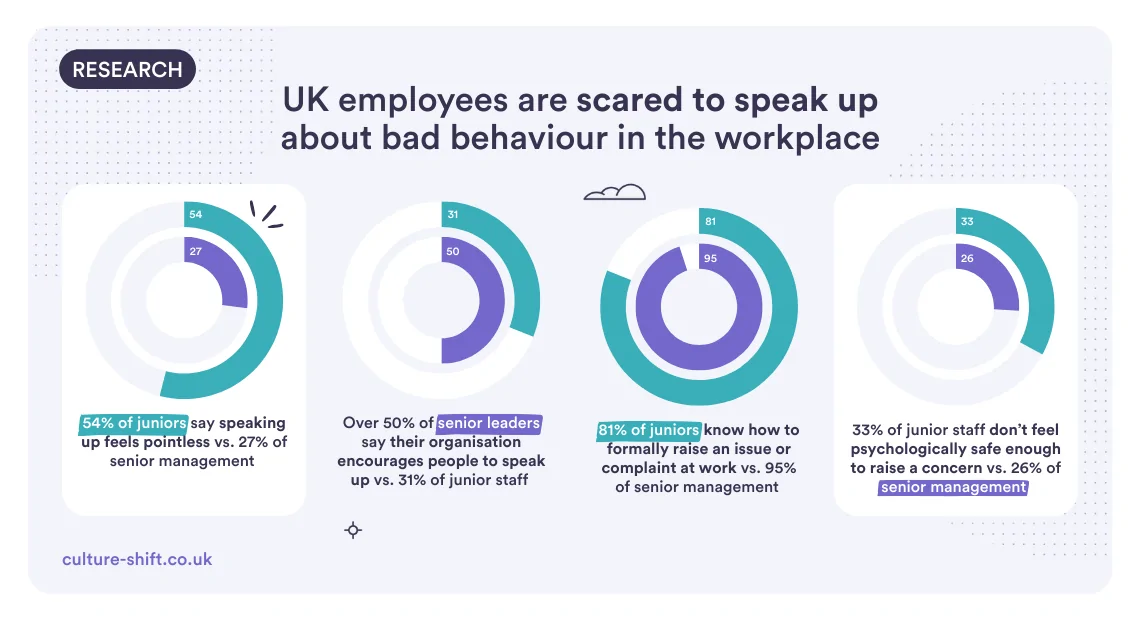
We also found that just 3 in 5 UK employees feel safe using formal speak up channels to report bad behaviour at work. While more than two thirds of employees said their workplace offers anonymous channels to report bad behaviour, 41% said they were concerned they’d be identified even if reporting anonymously.
These research findings tell us that significant work needs to be done across UK businesses to create cultures where everyone feels safe to speak up.
Empowering people to do this starts by openly inviting – and accepting – feedback on working practices and organisational culture; offering confidentiality and anonymity (where required) for people who do speak up; demonstrating that something will be done about it when someone does have the courage to speak up, and perhaps most importantly, working hard every day to create a culture where speaking up is encouraged, valued and respected. This needs modelling at all levels within businesses, so employees, regardless of seniority, feel psychologically safe to speak up.
What we're reading
Latest insights from the front lines of workplace culture.

5 Things Every FE Provider Should Do Under the New Ofsted Toolkit
Ofsted's new FE toolkit grades inclusion separately. Colchester Institute's Stefan Jordan shares five steps to evidence impact and prepare for inspection.




Feeling inspired?
Take the first step toward preventative misconduct management with a demo of our Report + Support™ platform. We can show you how to breakdown reporting barriers with anonymous 2-way messaging, and how to act before things escalate with name-matching and pattern-spotting across our analytics dashboard.