The Confidence vs Compliance Gap That Could Catch Employers Out

Our latest research, surveying 300 HR leaders, has exposed a dangerous mismatch between what employers believe and what they can actually prove.
91% of HR leaders are confident their organisation could evidence "all reasonable steps" were taken to prevent sexual harassment. Only half can back that up with a clear reporting process, and only half can evidence the actions taken once a report is made.
This gap matters more than ever. From October 2026, the Employment Rights Act will place a legal duty on employers to take all reasonable steps to prevent sexual harassment. Speaking to HR Magazine, employment law partner Matt Jenkin warned that confidence at this level is often misplaced at tribunal, and that the shift to "all reasonable steps" raises the bar further still.
As Gemma McCall, CEO and Co-founder of Culture Shift, put it:
"Evidence is crucial, and that's where most organisations fall short."
A policy, a training session, a risk assessment: none of it counts as evidence unless it's documented, dated, and reviewed.
The second finding cuts to the heart of the problem. Nearly 60% of employees who experienced harassment didn't report it. That means the vast majority of organisations relying on report volume as a proxy for safety are working from an incomplete picture, at best.
Gemma McCall's advice is to stop reacting to reports in isolation and start understanding prevalence. Anonymous reporting routes, paired with regular surveys that ask specific questions about harassment, give organisations a baseline they can track over time. A trend line becomes evidence in its own right, showing that prevention was actively considered rather than assumed.
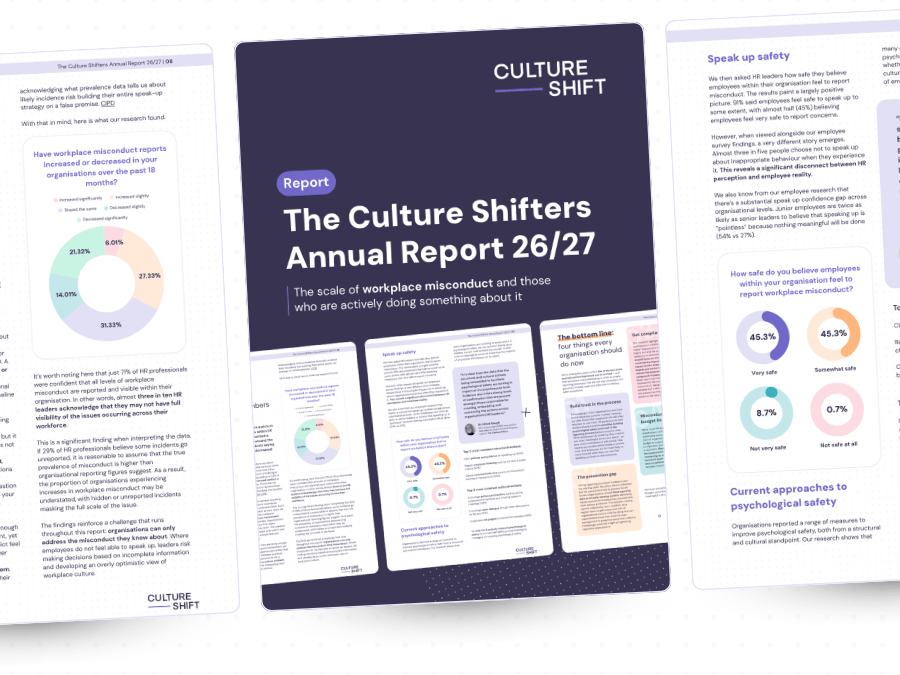
Read the full article on HR Magazine, and for the full breakdown of the statistics in the article, download The Culture Shifters Annual Report.
.png)
What we're reading
Latest insights from the front lines of workplace culture.

5 Things Every FE Provider Should Do Under the New Ofsted Toolkit
Ofsted's new FE toolkit grades inclusion separately. Colchester Institute's Stefan Jordan shares five steps to evidence impact and prepare for inspection.



Feeling inspired?
Take the first step toward preventative misconduct management with a demo of our Report + Support™ platform. We can show you how to breakdown reporting barriers with anonymous 2-way messaging, and how to act before things escalate with name-matching and pattern-spotting across our analytics dashboard.