
Are you taking reasonable steps to prevent workplace harassment?
.png)
Preventing workplace harassment is no longer a ‘nice to have’, it’s essential. For too long, organisations have adopted a reactionary approach to harassment in the workplace, tackling incidents on an individual basis as and when they arise.
However, we now know this approach doesn’t work. Not least because employees often don’t feel confident enough to tell their employer about harassment until it’s too late, and they’ve either exited the business or blown the whistle.
Harassment can occur in any setting, not just the work place. But if it does occur in the workplace then the employer can be liable unless they can show they took all reasonable steps to prevent harassment.
With the Equality and Human Rights Commission (EHRC) using its enforcement powers to come down on employers who are failing to protect people from harassment, it’s more important than ever to take a preventative approach.
The first high-profile case of this was in August 2020, when leading supermarket chain Sainsbury’s had to sign a legally binding agreement with EHRC, after being found liable for sexual harassment against a member of staff.
These agreements are called Section 23s, and Sainsbury’s have since been joined by the likes of Highways England, The Department for Work and Pensions (DWP) and Pontins. In the case of Highways England this follows an employment tribunal which resulted in awarding a staff member £74,000 in compensation for sexual harassment and unfair dismissal.
The agreements require these organisations to take all “reasonable steps” to prevent harassment and include recommendations like:
- Appointing Equality, Diversity and Inclusion champions across the organisation
- Completing risk assessments in relation to sexual harassment and putting mitigations in place to manage identified risks
- Advising employees on how to deal with harassment through internal communications
- Provide enhanced training on equality law and Equality, Diversity and Inclusion for all employees
- Providing regular progress reports to the regulator
The above recommendations are unique to those organisations, but the EHRC have previously released an outline of what they’re calling a “7 step approach” to tackling harassment for all employers. If you follow these 7 Steps now, it’s less likely you’ll be called out by the EHRC down the line for failing to protect people from harassment.
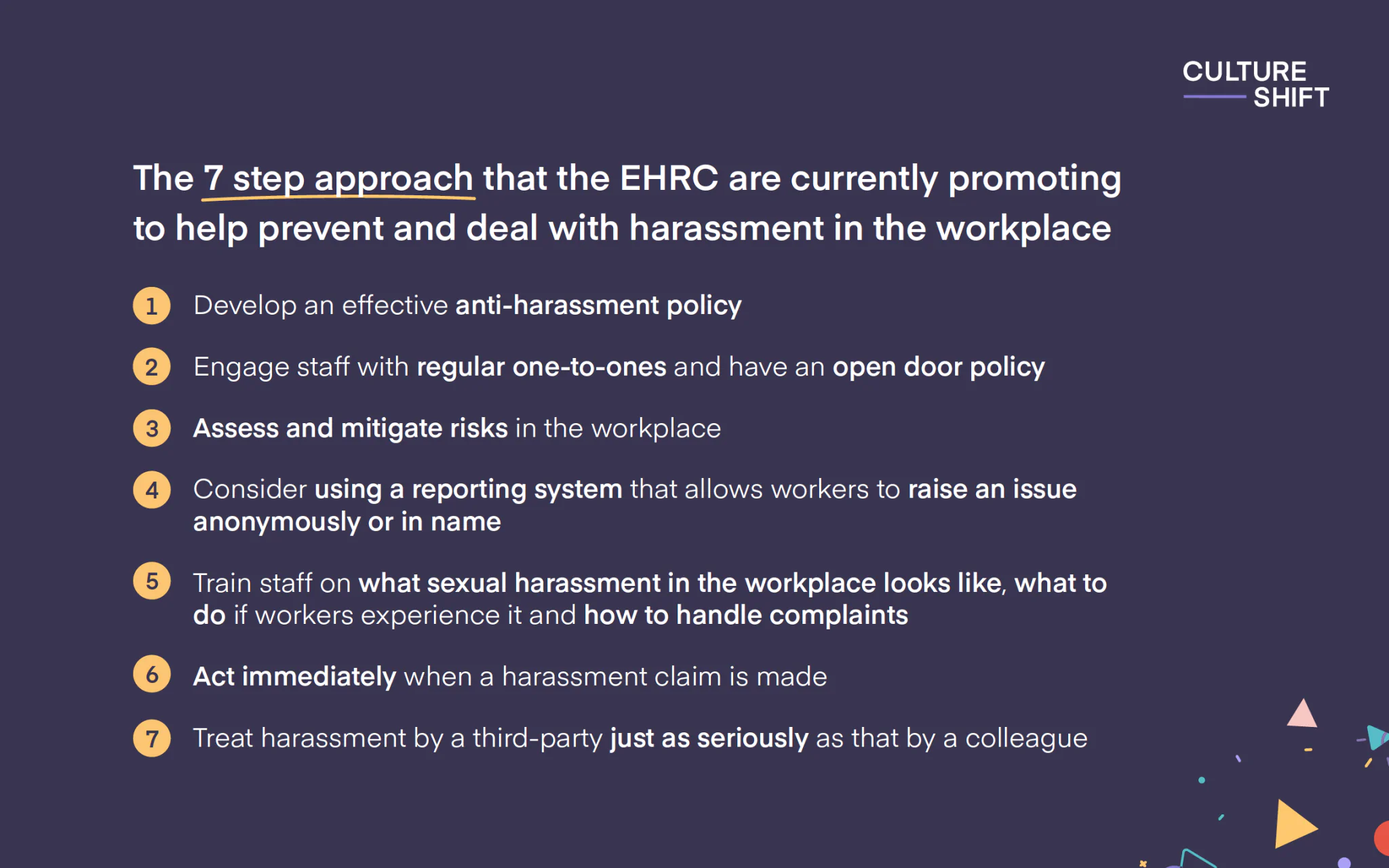
We recently discussed the measures set out in EHRC’s technical guidance in one of our webinars, and provided some practical examples of how to tackle and respond effectively to harassment. Catch up on the webinar with Culture Shift and law firm Hill Dickinson.
The most recent Section 23 agreement we’re aware of, signed in April 2021, was with East of England Ambulance Service Trust (EEAST) who were reported by The Care Quality Commission following an investigation.
EEAST are required, amongst other things, to conduct a staff survey to assess levels of sexual harassment within the Trust and to conduct regular pulse surveys to monitor progress against the initial findings.
We know that there are a number of factors, including fear of not being believed, and worrying about repercussions, that put people off responding honestly to surveys. If EEAST are truly committed to tackling and preventing harassment we’d recommendimplementing a year-round anonymous listening tool – something which is pointed out in the 7 step approach. Anonymous reporting platforms, like Culture Shift’s Report + Support, allow employees to safely and confidently speak out about harassment at the time and place that’s best for them, without needing to attach their name to their report.
Failing to take necessary steps to preventing workplace harassment opens your organisation up to significant financial and reputational risk.
Culture Shift have years of experience working with organisations to implement all the steps and recommendations outlined in this blog, and more. Get in touch with us to discover how we can help you.

What we're reading
Latest insights from the front lines of workplace culture.

5 Things Every FE Provider Should Do Under the New Ofsted Toolkit
Ofsted's new FE toolkit grades inclusion separately. Colchester Institute's Stefan Jordan shares five steps to evidence impact and prepare for inspection.




Feeling inspired?
Take the first step toward preventative misconduct management with a demo of our Report + Support™ platform. We can show you how to breakdown reporting barriers with anonymous 2-way messaging, and how to act before things escalate with name-matching and pattern-spotting across our analytics dashboard.