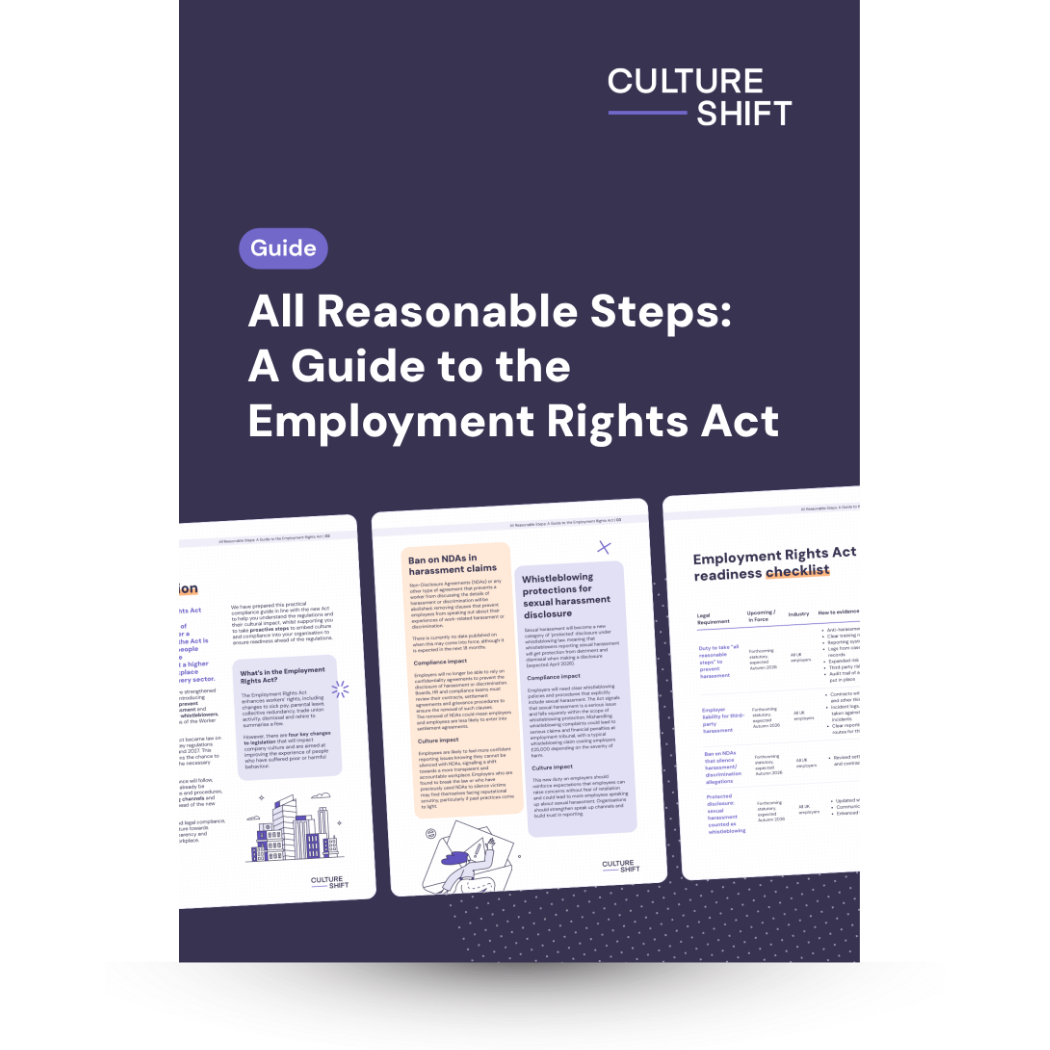
All Reasonable Steps: A Guide to the Employment Rights Act
The Employment Rights Act represents the most significant overhaul of UK workplace rights in over a decade, introducing stronger employer duties around harassment prevention, whistleblowing protection and workplace accountability across every sector. This comprehensive guide explains what the changes mean in practice, and what organisations need to do now to prepare. Download the guide to:

Understand how the Employment Rights Act strengthens employer duties around harassment, sexual harassment and workplace conduct

Identify the cultural, legal and operational risks

Learn what "good" looks like under the new expectations for prevention, reporting and transparency

Build a practical roadmap for HR, Legal and Leadership teams ahead of implementation
The reality in numbers
Workplace misconduct remains significantly underreported across UK organisations, despite growing awareness of its impact on people, culture and business performance. Our research highlights a persistent gap between lived experience and formal reporting, driven largely by fear of consequences and lack of trust in speak-up processes.
60%
incidents go unreported
60% of people who have experienced bullying or harassment at work over the past 12 months did not report it.
37%
too risky
37% said speaking up is not worth the personal risk.
28%
affected directly
Over a quarter of people have experienced bullying or harassment at work over the past 12 months.


More about All Reasonable Steps: A Guide to the Employment Rights Act
Big changes are coming for employers across all sectors. The Employment Rights Act introduces significant reforms that strengthen worker protections and increase employer responsibility for preventing harassment, sexual harassment and other forms of workplace misconduct. It also expands protections for whistleblowers and builds on the principles established by the Worker Protection Act.
These changes mean that employers will be expected to take a more proactive approach to preventing harmful behaviour in the workplace. This includes not only having appropriate policies in place, but also being able to demonstrate how those policies are embedded in practice through reporting mechanisms, training, leadership accountability and ongoing monitoring of workplace culture.
The Employment Rights Act also places greater emphasis on transparency and accountability, signalling a shift towards more visible enforcement of workplace standards. Employers will need to show that they are actively identifying risks, responding appropriately to concerns, and taking steps to prevent recurrence, rather than relying on reactive processes after issues arise.
All Reasonable Steps: A Guide to the Employment Rights Act provides a clear breakdown of what these changes mean in practice, how they will affect employers across different sectors, and what organisations need to start doing now to prepare for implementation.
Download your copy
FAQs
Questions? We've got answers.
The Employment Rights Act is a major reform to UK employment law that strengthens worker protections across all sectors. It introduces enhanced employer duties relating to harassment prevention, third-party conduct, whistleblowing protection and workplace transparency, with a stronger focus on prevention rather than reaction.
The Act significantly raises expectations on employers to prevent harassment and sexual harassment, manage third-party misconduct, strengthen whistleblowing protections, and ensure workplace processes are transparent, consistent and evidence-led. It shifts responsibility towards proactive prevention and demonstrable cultural accountability.
The Act makes workplace culture a compliance issue as well as an operational one. Employers are expected to actively prevent harmful behaviour, not just respond to it. This includes building safer reporting environments, reducing fear of retaliation, and ensuring leadership accountability for behavioural standards.
Sexual harassment in the workplace is officially classified as a "qualifying disclosure" under UK whistleblowing law. The Act strengthens protections for employees raising concerns about workplace misconduct, including harassment and discrimination. It reinforces the expectation that organisations must provide safe, accessible and trusted reporting channels without fear of retaliation.
Organisations that fail to align with the Act risk increased employment tribunal claims, reputational damage, reduced employee trust and greater scrutiny of workplace culture and governance practices. Weak reporting systems and poor handling of misconduct will be key risk indicators.
The guide helps employers translate the requirements of the Employment Rights Act into practical, operational steps that can be implemented across HR, compliance and leadership teams. It breaks down what the legislation means in practice and highlights where organisations are most likely to be exposed if systems, reporting mechanisms and cultural controls are not strengthened ahead of implementation.
Culture Shift supports organisations in meeting the expectations set out in the Employment Rights Act by helping them move from reactive processes to proactive prevention. Through Report + Support™, organisations can provide safe and accessible channels for reporting harassment, bullying and other workplace concerns, including from third parties, while maintaining full visibility of trends and case outcomes through structured case management and reporting data. This enables organisations to evidence how concerns are being identified, escalated and addressed in practice, which is central to demonstrating compliance. In addition, Culture Shift’s preventative insight capabilities help organisations identify patterns of misconduct early, understand cultural risk hotspots, and take action before issues escalate. Alongside this, targeted sexual harassment training helps strengthen understanding of expected behaviours, improve manager capability, and reinforce a consistent standard across the organisation. Together, these tools support employers in building the kind of evidence-based, preventative culture that the Employment Rights Act increasingly expects to see.
Still have questions?
The ever-changing regulatory landscape can be tricky to navigate - we're here to guide you through what your organisation needs to do to stay compliant and protect your people.


Your partner in preventing workplace misconduct
Misconduct rarely starts as a headline issue - it starts with something small that goes unaddressed. Culture Shift helps organisations surface concerns early, respond consistently, and embed long-term cultural change through our Report + Support™ platform, trauma-informed training programmes, and community-led best practice.