Dr Judith Grant
What does it actually cost an organisation to wait until a problem escalates? Dr Judith Grant has spent two decades answering that very question in a range of workplaces, including time as Head of Occupational Health and Wellbeing at Royal Mail Group and Director of Health and Wellbeing at Mace - and now as Managing Director of her own consultancy, The Wellbeing Exchange.

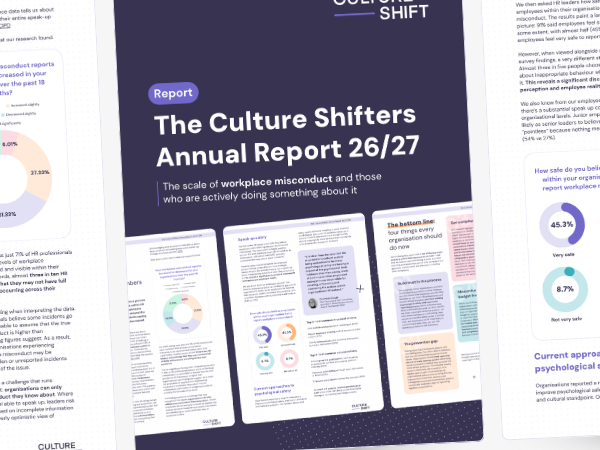
The Culture Shifters Annual Report 26/27
By mapping datasets from HR leaders and employees together, our inaugural Culture Shifters Annual Report reveals the gaps between what organisations believe about their culture and what employees actually experience, as well as where the biggest opportunities for meaningful change lie.

When we asked Dr Judith Grant why organisations believe their people feel safe to speak up, while almost two-thirds of employees stay silent, she didn't hesitate.
Perception and reality rarely match
Our Culture Shifters Annual Report found that 91% of HR leaders believe their people feel safe to speak up, while 57% of employees who experience bullying or harassment stay silent. Dr Grant sees this same pattern across many organisations, not just around misconduct, but across wellbeing and stress more broadly.
"There's often a gap between perception and reality when looking at psychosocial risks within the workplace. I wonder whether that's a similar story here with the people Culture Shift have surveyed. A lot of the work might be reactionary."
The annual report backs that up. Only 41% of organisations consistently aggregate and analyse their speak-up data to identify patterns, and just 1 in 5 actively measure psychological safety at all. Confidence in a process and evidence that the process works are two different things, and the report shows most organisations currently have more of the former than the latter.
Silence has a cost, and so does an unanswered report
Judith points to communication, or the lack of it, as one of the biggest drivers of the psychological safety gap.
"There might be an absolutely brilliant process in place for managing bullying within the workplace, but if employees don't know about it, or there isn't that feedback loop, that can be a real problem. Communication is absolutely key. Even if it's just to say, we're still working on this - that can make a real difference."
Our data shows why this matters. Only 58% of organisations consistently monitor what happens to employees after they report a concern, leaving 42% doing so occasionally or not at all. Response times tell a similar story: just over half of HR leaders acknowledge a report within 24 hours, while almost 1 in 10 take up to a week or longer. Judith's point is that every one of those gaps registers as anxiety for the person waiting on the other end, whether or not the organisation is actually making progress behind the scenes.
The price of staying reactive
Judith cites recent Deloitte research putting the cost of absenteeism, presenteeism and turnover at £52 billion annually across UK organisations. Our research adds another dimension to that cost: 87% of organisations told us they feel exposed to risk from workplace misconduct, with 1 in 5 rating themselves highly exposed, and 1 in 10 HR professionals now spend more than a day a week dealing with misconduct issues directly.
"Being proactive is going to be cheaper for organisations in the long run, both from an outcomes perspective and because there's now a greater legislative drive for organisations to act."
Judith's one tip for employers...
"Don't just measure it, act on it."
For Judith, that means building a genuine feedback loop rather than a one-off survey: training line managers so they know what to do when something is raised, making sure employees understand how to escalate, and communicating consistently even when there's nothing new to report. Our report found real room to close that gap. Only 46% of organisations currently provide managers with training on creating psychological safety, and just 38% offer regular role-specific training for handling misconduct reports at all.
"It takes a lot to escalate and to report when a fellow colleague is acting in ways that they shouldn't be. You need to make sure that person feels supported through that process, and that goes for everyone involved in a misconduct case, not just the person who raised it."
Dive into some of the topics Judith discussed...
Did you know 91% of HR leaders are confident they could evidence all reasonable steps today, but only 38% have completed the risk assessments needed to prove it? Our inaugural Culture Shifters report explores the full compliance countdown facing UK employers, including the Employment Rights Act, third-party harassment protections, and the case study of Hunter v Lidl GB. Download your copy to discover:
The perception gap that's putting you at risk: why HR leaders feel confident and employees stay silent
The hidden cost of reactive culture: how much time and budget misconduct is quietly consuming
What "audit-ready" really means, and why most organisations can't prove compliance despite believing they can
.png)

Your partner for compliance and culture change
Regulators won't just ask what you have in place, they'll ask what you've done. Book a demo to see how Report + Support™ helps you evidence compliance, reduce legal exposure, and build a workplace where issues are prevented, not just managed.