
Hina Belitz
When does compliance stop being enough to protect your organisation? Drawing on years of experience representing employees and advising organisations through discrimination, harassment and dismissal claims, Hina Belitz, Partner in Employment Law at Excello Law, tackles this question and more. Hina shares her take on the gap between what the law requires and what real justice looks like, the wave of legislative change reshaping employer obligations, and why waiting for a tribunal claim is the most expensive strategy an organisation can choose.
.png)
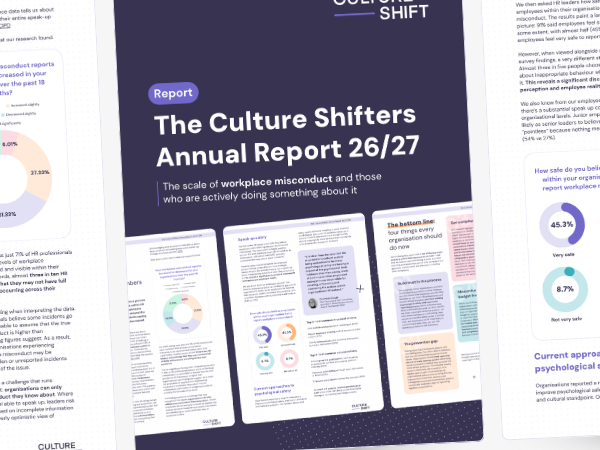
The Culture Shifters Annual Report 26/27
By mapping datasets from HR leaders and employees together, our inaugural Culture Shifters Annual Report reveals the gaps between what organisations believe about their culture and what employees actually experience, as well as where the biggest opportunities for meaningful change lie.

When we sat down with Hina Belitz to hear about her career journey and unpack the findings of our latest Culture Shifters report, she was direct about the distance between what the legal system delivers and what employees actually need.
Where real change has to happen
Hina is clear that closing this gap cannot be left to individual managers or HR teams working alone.
"Change has to happen where the real power sits."
The report's findings on leadership make the case for her directly. 68% of organisations either have no dedicated budget for misconduct and culture work or must compete for funds from another pot, and only 39% share misconduct and speak-up data with their board on a regular basis. Without that visibility and buy-in at the top, the policies and training in place lower down remain "surface-level activity."
The cost of staying quiet
Ask Hina why toxic environments persist for as long as they do, and she points to how much a job represents for the person holding it.
"I don't think people in power appreciate just how central your job is to you. It determines everything."
That fear shows up directly in the data. 57% of employees who experience bullying or harassment choose not to report it, and among those who stay silent, over a third say it simply wasn't worth the personal risk. The report also found that junior employees are twice as likely as senior leaders to believe speaking up is "pointless" because nothing will change. Hina's point is the human reality behind that statistic: people protect their income before they protect their voice.
Proactivity is the absolute key
On the legal changes heading towards UK employers, Hina's advice is blunt.
"In short, sharp summary: proactivity is the absolute key. Reactivity is history."
The report shows most organisations already agree with her in principle: 57% describe their approach to misconduct as proactive and preventative. But the practical foundations tell a different story. Only 38% have completed risk assessments, and just 33% put measures in place to prevent retaliation. With the Employment Rights Act's "all reasonable steps" duty and new third-party harassment protections landing in October 2026, the report sets out exactly where that readiness gap needs closing first.
Hina's one tip for employers...
"The most important thing is to put workplace misconduct at the top of your agenda. What will fix it is a multifaceted approach that takes account of everything, and looks at it strategically at boardroom level."
That lines up with what the report found among organisations that have actually made the shift from reactive to proactive. They are rarely the ones with the most sophisticated systems. They are the ones where someone at senior level has decided that understanding culture is a strategic priority, not an administrative function, and where the response spans budget, board reporting, risk assessment and training rather than any single fix.
Dive into some of the legal changes Hina discussed...
Did you know 91% of HR leaders are confident they could evidence all reasonable steps today, but only 38% have completed the risk assessments needed to prove it? Our inaugural Culture Shifters report explores the full compliance countdown facing UK employers, including the Employment Rights Act, third-party harassment protections, and the case study of Hunter v Lidl GB. Download your copy to discover:
The perception gap that's putting you at risk: why HR leaders feel confident and employees stay silent
The hidden cost of reactive culture: how much time and budget misconduct is quietly consuming
What "audit-ready" really means, and why most organisations can't prove compliance despite believing they can
.png)


Your partner for compliance and culture change
Regulators won't just ask what you have in place, they'll ask what you've done. Book a demo to see how Report + Support™ helps you evidence compliance, reduce legal exposure, and build a workplace where issues are prevented, not just managed.