Christine Bonney
Why do employees feel less safe to speak up than HR leaders think they do? Christine Bonney, Head of Culture Transformation at Culture Shift, tackles this question and more, sharing her take on building a genuine speak-up culture, the hidden costs of a reactive culture, and why culture change initiatives commonly fail, drawing on years of frontline experience with vulnerable communities in the UK and the Middle East.
.png)
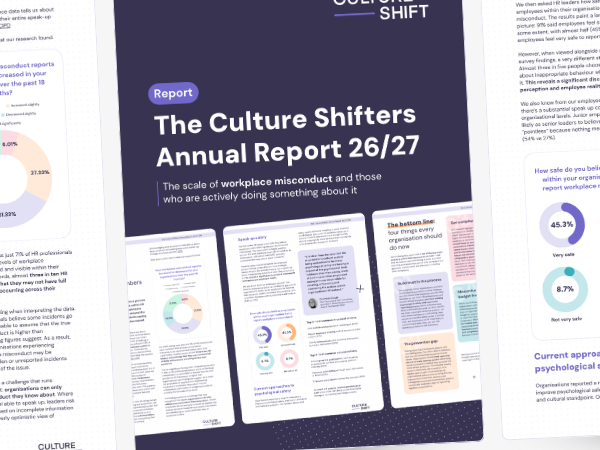
The Culture Shifters Annual Report 26/27
By mapping datasets from HR leaders and employees together, our inaugural Culture Shifters Annual Report reveals the gaps between what organisations believe about their culture and what employees actually experience, as well as where the biggest opportunities for meaningful change lie.

When we sat down with Christine Bonney to hear about her career journey and unpack the findings of our latest Culture Shifters report - she didn't hold back on what the data actually reveals about the gap between how organisations think they're performing and how employees experience reality.
The perception gap
Our report found a stark divide: HR leaders believe employees feel safe to speak up at far higher rates than employees themselves report. Christine's explanation goes beyond policy gaps. She points to something harder to fix with a handbook update: the emotional weight an individual carries when deciding whether to come forward.
"HR, or a company, can have the best processes in the world, best people in the world dealing with these things, but if you're an individual that's experienced harmful behaviour, you're facing potential emotional stress - how somebody actually feels when something bad has happened to them, in terms of safety to speak up, is a very different matter."
This is worth sitting with. Organisations can build the most transparent reporting process available and still fail to close this gap, because psychological safety isn't something an employer can declare on someone else's behalf. It has to be felt, and it's shaped by what people have witnessed happen to colleagues before them.
On the cost side of the same report, Christine was equally direct about what a reactive approach actually costs a business.
"A reactive culture - waiting and hoping that a problem won't occur and then reacting to it if it does - is more costly than taking proactive preventative steps."
Beyond the obvious legal fees and tribunal risk, she flagged the hidden costs: absenteeism, lower productivity, and staff who "vote with their feet" rather than fight a battle they assume they'll lose.
Why culture change initiatives fail
Ask Christine why so many culture change efforts stall, and the answer isn't a lack of good intentions. It's a lack of resourcing. She cited a statistic that should give any leadership team pause.
"68% of organisations have no dedicated budget for change work, and so we're expecting all of this to happen for free."
That's the crux of it. Culture change is frequently handed to people already stretched across other responsibilities, with no budget line and no long-term strategic backing. It's treated as a side project rather than core business infrastructure, which makes it nearly impossible to sustain once the person driving it moves on or burns out.
Christine's one tip for employers...
"Look at workplace misconduct holistically, and not just as a part of compliance with a specific legal requirement or regulatory requirement."
Christine's tip cuts against how most organisations approach workplace misconduct. Compliance sets a floor, not a culture. Ticking the boxes required by legislation such as the Employment Rights Act or FCA Non-Financial Misconduct won't on its own build an environment where people trust the process enough to use it. That trust is built earlier, in recruitment, onboarding, management behaviour, and the everyday norms that either reinforce or undermine an organisation's stated values.
Employers waiting for regulation to tell them what to fix will always be a step behind. The ones treating culture as a continuous discipline, not a periodic compliance exercise, are the ones actually closing the gap.
Dive into some of the numbers Christine discussed...
Did you know 9 in 10 HR leaders believe that employees in their organisation feel safe to speak up about workplace misconduct, but almost 60% of employees choose not to report bullying or harassment last year? Our inaugural Culture Shifters report explores the gap between perception and reality and what the organisations that are actively shifting culture and proactively addressing workplace misconduct are doing differently. Download your copy to discover:
The perception gap that's putting you at risk: why HR leaders feel confident and employees stay silent
The hidden cost of reactive culture: how much time and budget misconduct is quietly consuming
What "audit-ready" really means, and why most organisations can't prove compliance despite believing they can
.png)


Your partner for compliance and culture change
Regulators won't just ask what you have in place, they'll ask what you've done. Book a demo to see how Report + Support™ helps you evidence compliance, reduce legal exposure, and build a workplace where issues are prevented, not just managed.