For decades, the creative industries have operated under a silent contract. In exchange for the opportunity to work in world-class institutions, staff and freelancers were often expected to tolerate “difficult” environments. Harmful behaviour was frequently excused as a byproduct of creative brilliance or simply accepted as part of the job.
However, the release of the CIISA Standards Framework 2025 marks a definitive end to this era. For HR and People Directors, the message is clear: the creative sector is undergoing a necessary transformation. Compliance is no longer just about avoiding litigation; it is about dismantling the whisper networks that have governed the corridors for too long.
The scale of the challenge
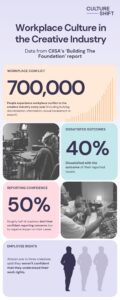
Data highlighted in the CIISA Building the Foundation report suggests that roughly half of those working in the creative industries have experienced discrimination, bullying, or neglect.
Gemma McCall, CEO of Culture Shift, notes that the impact of this culture is far-reaching. “People described harmful behaviour as something that is still treated as just part of the job or excused because of someone’s perceived genius,” she explains. “Many freelancers talked about the fear of being labelled difficult or losing future work if they spoke up about things. And that fear leads to silence.”
This silence is not empty. It manifests as WhatsApp messages and warnings passed in corridors. As Gemma points out, “the opacity of those whisper networks makes it even more difficult for organisations to tackle what are already pretty hidden behaviours.”
For HR Directors balancing tight budgets and production schedules, the human cost is mirrored by a staggering economic one. CIISA’s economic modelling estimates that 700,000 people across the creative industries experience harm every year. The financial and creative drain on the sector is enormous, particularly in theatre, where two thirds of the workforce is self-employed.
The National Theatre (NT) recognised that their prestigious standing required a proactive approach to these risks. Sarah Dean, People Policy and Engagement Partner at the NT, explains that their shift began by acknowledging the unique needs of their workforce. During a typical year, the NT employs up to 1,500 people, including roughly 500 freelancers.
“The freelancers would range from an actor on the stage through to someone with specialist marketing skills,” Sarah says. “We want to understand how we could establish a speak up culture… if I report what will happen to me, and is there an anonymous route?”
Transitioning to CIISA Standards
The CIISA 2025 standards place a heavy emphasis on open and accountable reporting mechanisms. To meet these standards, the National Theatre moved beyond traditional HR policies, implementing an “Everyone is Welcome” statement that flipped the old “customer is always right” mentality on its head.
But a policy on a wall is only as effective as the system behind it. This is where the transition from “whisper networks” to professional reporting occurs. By adopting Culture Shift’s Report + Support system, the NT has provided a safe, trusted, and anonymous route for individuals to flag concerns.
This move aligns directly with the CIISA requirement for transparency. It acknowledges that for a freelancer or a mid-level worker, the risk of speaking up is often perceived as greater than the benefit of staying silent.
The path forward
The path to CIISA compliance does not have to be an administrative burden. It is about replacing fragmented, hidden conversations with a centralised, secure platform. This is where Culture Shift’s Report + Support becomes an essential tool for the modern creative institution.
The platform is built specifically to dismantle the barriers that prevent people from speaking up. By offering a truly anonymous reporting route, it provides a safe space for freelancers and staff who fear the professional repercussions. Crucially, the system facilitates two-way messaging, allowing HR teams to communicate directly with anonymous reporters. This enables administrators to gather vital details and provide updates without compromising the individual’s identity, fostering that all-important level of trust.
Beyond individual reports, the platform provides robust data analytics that transform reports into actionable insights. For arts and media institutions, this means the ability to identify specific departments or productions where harmful behaviours may be clustering. Instead of reacting to crises, HR & People Directors can use these trends to deploy resources where they are most needed, proving to stakeholders, auditors and the public that they are taking a proactive, evidence-based approach to safeguarding.
Supporting the creative ecosystem
By adopting Report + Support, institutions like the National Theatre are investing in the long-term creative and financial health of their organisations. It sends a clear message to the 700,000 people currently at risk: the era of the excused genius is over, and the era of the protected professional has begun.
Watch the full National Theatre webinar on-demand.
Find out what an anonymous reporting platform can do for your organisation. Book your demo today.