For a long time, the team at a busy partner organisation knew that their current way of working was no longer sustainable. Using Report + Support to receive incoming reports, they were providing a secure and accessible way for people to come forward. Yet when the actual casework began, the process moved away from the digital space and into a world of manual administration.
To triage cases, assess risk, or create support plans, the team relied on a mix of printed paper forms and various Word documents saved across different folders and drives. While this was a method born out of necessity, the strain was starting to show. Caseworkers found themselves spending a large portion of their day on repetitive admin tasks. They were re-typing notes from meetings and searching for the latest version of a risk assessment template. The actual work of supporting individuals was buried under a mountain of paperwork.
The administrative burden was not just a matter of lost time; it also created risk. When information is stored in separate places, it is much harder to see the full picture of a case. Risks can be harder to track, and ensuring accountability for specific actions becomes difficult to manage. Paper documents can be susceptible to data breaches while maintaining version control of digital documents can also cause issues.
The team had been using the same risk assessment template for the past 7 years. Several caseworkers had amended versions of the document over time, but it still felt outdated and did not take into account the varied ways in which individuals reporting harmful behaviour can be at risk of further harm.
The team knew something had to change. They wanted to update their case management process, including the forms used, and centralise everything onto Report + Support. They hoped to bridge the gap between receiving a report and taking action, more effectively manage risk and reduce admin workload for staff. They decided to adopt Case Management Forms.
Person-centred support and more accurate assessment of risk with expert templates
Starting with a blank page can be one of the biggest barriers to changing a work process. Instead of having to design their own forms from scratch, the team utilised the pre-built templates designed by sector experts.
The report screening template provides a framework to quickly assess risk on incoming reports and triage appropriately. The framework includes a checklist of questions and is designed to be used whilst scanning a report to quickly identify risk related to the reporting party, the responding party, the organisation and others. By adopting this form, the team were able to develop a more efficient process for report triage and allocation which enables urgency and risk to be considered from the start of the case management process.
The voice of the individual making a report can sometimes be lost when the case management process kicks in. Balancing responsibilities both towards the reporter and responding party, a need to establish what has happened, or organisational procedures can sometimes drown this out. The individual risk assessment template and individual support plan template ensure that this does not happen.
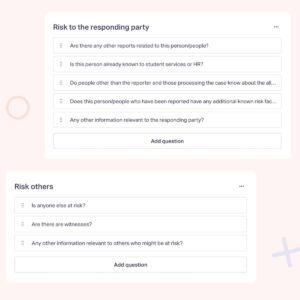
The risk assessment template considers risk in the whole; whether relating to the incident itself, the behaviour of the responding party, the circumstances of the reporter, or other factors such as the presence of third parties or the use of technology. It can be used as a conversation guide, to give confidence to caseworkers to ask the sometimes difficult questions that lead to a better understanding of risk. The simple RAG (Red, Amber, Green) rating section for each area of risk enables a caseworker to analyse risk levels whilst completing the form, and finally give an overall risk rating.
The individual support plan template ensures that all risks and support needs identified for each area of risk are adequately addressed, with actions assigned to a responsible staff member by a specified date.
Through implementing these templates, the team found a way to improve accountability, transparency and risk management whilst retaining the person-centred support that is a fundamental part of their service.
The power of customisation
While the templates provided a solid foundation, the team soon discovered that the strength of the feature was also its flexibility. Every organisation has its own unique way of handling cases, influenced by internal policies and specific community needs. This partner was no different.
They began to customise the existing templates to match their specific requirements. They added fields that were relevant to their internal reporting lines and adjusted the language to match their organisation. If a particular section of a template didn’t apply to their context, they simply removed it.
Eventually, they went a step further and built a new form from scratch; moving a referral form which had always existed in Word directly into the platform. There was no more switching between different apps or worrying about which version of a form was the most recent; all cases had a single home on the platform.
Reclaiming time for what matters
The reduction in manual data entry and filing has given the caseworkers their time back. They are no longer slowed down by the mechanics of paperwork and can instead focus on the quality of the support they provide. The time that was once spent on tracking down a missing action plan is now spent on helping individuals navigate their options and recover from their experiences.
Efficiency has also led to better consistency. With everyone using the same digital forms and templates, the standard of documentation, case management and risk assessment has risen across the board.
With a streamlined system in place, the team is now better equipped to handle the complexities of casework, ensuring that no detail is lost and every person receives the care they deserve.
Find out how Case Management Forms can work for you
If you would like to learn more about how these tools can help your team reduce their administrative workload and focus on support, we would love to hear from you.
Please get in touch with your Customer Success Manager for a detailed walkthrough of the features, or speak with our sales team to find out how you can get started. We are here to help you build a workflow that works for your organisation.